
Energy Drinks Usage in Sports – Advantages, Disadvantages

What Pakistani Athletes Need to Know
Walk into any gym in Lahore, step onto any cricket ground in Karachi, visit any football training session in Islamabad — and you’ll find at least one player sipping an energy drink before, during, or after their session.
Red Bull. Monster. Power Horse. Sting. Speed. The cans are everywhere.
But here’s what most people don’t ask: does it actually help? Or are Pakistani athletes spending money on something that gives a short buzz and a hard crash — and potentially something worse down the line?
This guide cuts through the marketing and gives you the real picture. What energy drinks do inside your body, where they genuinely help sports performance, where they cause damage, and how to use them smartly if you’re going to use them at all.
1. What Are Energy Drinks? The Basics
Energy drinks are beverages marketed as stimulant drinks designed to enhance mental alertness and physical endurance. They’ve surged in global popularity since their late 20th-century inception and show no sign of slowing down. The global energy drinks market was valued at $72.23 billion in 2025 and is projected to hit $103 billion by 2030.
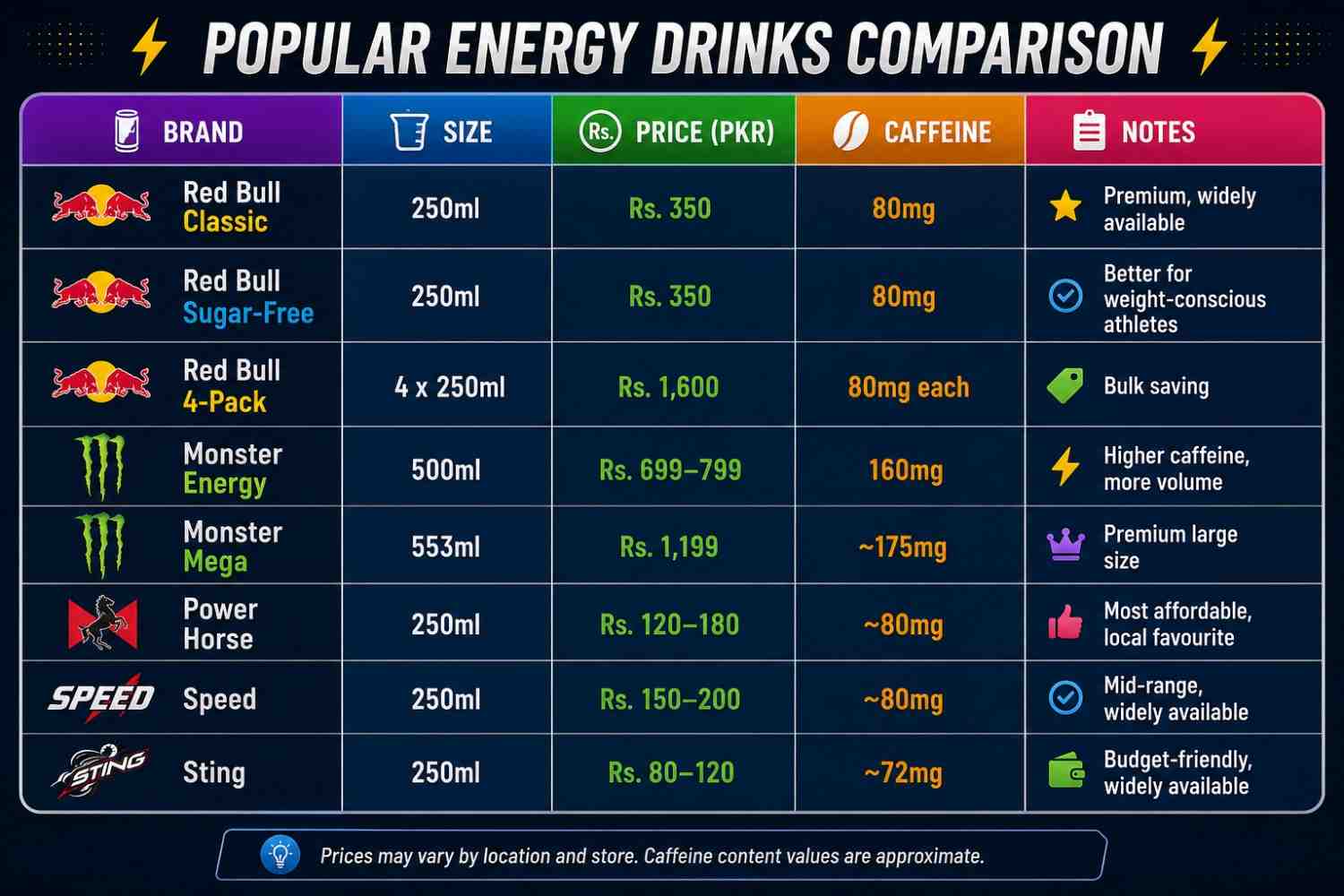
In Pakistan, the market is dominated by a handful of brands. Red Bull leads as the global premium option. Power Horse is the local favourite — a strong caffeine hit at a more accessible price. Monster is gaining market share among younger athletes. Speed and Sting round out the commonly available options.
These drinks are not all the same. They vary significantly in caffeine content, sugar levels, and ingredient profiles. A Red Bull (250ml) has 80mg of caffeine. A Monster (500ml) has 160mg. Power Horse sits somewhere in the middle. Understanding these differences matters before you decide whether — and how — to use them.
2. Key Ingredients and What They Actually Do
Most energy drinks share a core set of ingredients. Here’s what each one does – without the marketing language:
Caffeine
The most important ingredient. Caffeine works by blocking adenosine receptors in your brain. Adenosine is the compound that makes you feel tired. Block it and you feel alert, focused, and energized. Simple mechanism, well-understood science.
The performance benefits of caffeine in sport are real and well-documented. Both sports drinks with caffeine and energy drinks were effective in increasing several aspects of sports performance when the amount of drink provides at least 3mg of caffeine per kg of body mass.
For a 70kg athlete, that’s 210mg of caffeine – roughly two to three standard energy drink cans. The key word there is “at least.” The benefits kick in at meaningful doses, not at a single sip.
Taurine
An amino acid naturally found in meat, fish, and human muscle tissue. Taurine supports energy metabolism, neuronal function, and hydration at the cellular level. Energy drinks contain 1,000–2,000mg per can – significantly more than you’d get from food in one sitting.
The research on taurine combined with caffeine is mixed — some studies show the combination improves performance beyond caffeine alone, while others show little additional benefit. What is clear is that taurine reduces muscle damage markers and supports recovery, making it a useful addition regardless of its direct performance effect.
B Vitamins (B3, B5, B6, B12)
B vitamins support energy production at the cellular level. They’re involved in converting food into usable energy. They don’t give you a direct “buzz” – but they support the metabolic processes that keep you performing. Most people eating a reasonable diet have adequate B vitamin levels. In energy drinks, they’re more of a supporting cast than a star player.
Sugar
Most standard energy drinks contain 26–28g of sugar per 250ml can. That’s about 6–7 teaspoons. This sugar gives you a rapid glucose spike – fast energy that your muscles can use immediately. The problem is what follows: a blood sugar crash that can leave you more fatigued than before you drank it. Sugar-free variants avoid this but rely more heavily on caffeine for effect.
Guarana
A plant-based source of caffeine found in some energy drinks. Guarana releases caffeine more slowly than synthetic caffeine – meaning the energy effect builds more gradually and lasts longer. Some athletes prefer guarana-containing drinks precisely for this sustained release.
Ginseng
An adaptogenic herb added to some premium energy drinks. Ginseng is associated with reduced mental fatigue and improved reaction time. The doses in most energy drinks are low enough that the effect is marginal – but it’s present.
3. Types of Energy Drinks Available in Pakistan
Not all energy drinks are designed the same way. Understanding the categories helps you make a smarter choice:
Stimulant Energy Drinks (Most Common)
Red Bull, Monster, Power Horse, Speed, Dark Dog. High caffeine, high sugar (or sugar-free variant), designed for quick mental and physical stimulation. This is what most Pakistani athletes reach for.
Sports/Isotonic Drinks
Gatorade, Powerade. These are technically different from energy drinks — lower caffeine or none, focused on electrolyte replacement and hydration. Better suited for during-exercise hydration than pre-exercise stimulation.
Natural Energy Drinks
Made from natural ingredients — fruit juices, herbal extracts. Growing in popularity but less common in Pakistan. Lower caffeine, cleaner ingredient profile.
Herbal Energy Drinks
Shilajit Energy Drink has started to gain popularity in Pakistan, providing a more natural energy boost with added health benefits. A smaller but growing category for athletes looking for traditional alternatives.
4. Energy Drinks in Sports — The Real Advantages
Let’s be clear: energy drinks do work for sport. The research confirms this. Here’s what they genuinely deliver:
Improved Athletic Performance
Numerous studies have shown that drinking moderate doses of such drinks produces beneficial effects, as they considerably boost the sporting performance of elite athletes in various sports, including both endurance and explosive events. The association between performance and the consumption of energy drinks has been demonstrated in American football, soccer, athletics, volleyball, and handball.
For Pakistani athletes competing in cricket, football, or kabaddi – sports that require repeated explosive efforts – this is directly relevant.
Sharper Focus and Mental Clarity
Caffeine’s effect on the brain is well-established. It sharpens concentration, improves reaction time, and reduces the perception of effort. For sports that require sustained decision-making under fatigue – cricket fielding in the final session, football in the 80th minute, martial arts in later rounds — this cognitive edge is real and meaningful.
Delayed Fatigue
Energy drinks help delay the onset of fatigue during prolonged exercise. When you’re 70 minutes into a football match in Pakistan’s summer heat and every muscle is asking you to slow down, the caffeine in an energy drink continues to block adenosine, keeping your perceived effort lower and your output higher for longer.
Better Reaction Time
Studies consistently show caffeine improves reaction time – the gap between a stimulus and a physical response. For a cricket batsman reading a fast delivery, a football goalkeeper diving for a save, or a martial artist reading an opponent’s attack, improved reaction time translates directly into better performance.
Increased Strength Output
Research shows energy drinks can improve maximal strength and power output in resistance training. For gym-goers in Pakistan doing heavy compound lifts, a pre-workout energy drink can add one or two extra reps at a given weight – which compounds into real strength gains over time.
Reduced Perception of Pain
One of caffeine’s lesser-discussed effects is its ability to reduce the perceived intensity of muscle pain during exercise. You’re not actually less hurt – but it feels like it. For endurance athletes and team sport players late in competition, this psychological edge matters.
Red Bull vs Gatorade: Advantages and Disadvantages for Athletes
Should you grab a can of Red Bull before your workout, or is Gatorade the smarter choice? Both are popular, but they serve different purposes. Red Bull is designed to improve alertness and focus, while Gatorade helps replace fluids and electrolytes lost during exercise.
Red Bull: Advantages
- Improves mental alertness and focus.
- May reduce the feeling of fatigue due to caffeine.
- Can improve reaction time in some sports.
- Convenient before training (30–45 minutes prior).
Red Bull: Disadvantages
- About 80 mg caffeine per 250 ml can may cause jitters or poor sleep in sensitive people.
- Regular version contains about 27 g sugar.
- Does not replace fluids or electrolytes.
- Energy boost is temporary and may be followed by a crash.
Gatorade: Advantages
- Helps rehydrate after prolonged exercise.
- Replaces sodium and potassium lost through sweat.
- Supports endurance activities lasting over an hour.
- Provides carbohydrates during long sessions.
Gatorade: Disadvantages
- Contains added sugar.
- Does not improve alertness like caffeine.
- Usually unnecessary for short workouts.
- Can add excess calories if consumed casually.
5. The Disadvantages Nobody Tells You About
Here’s where the marketing stops and the research starts. Energy drinks have real risks — especially when used incorrectly, in excess, or by the wrong people.
Cardiovascular Stress
This is the most serious concern. Apart from their ergogenic effects, the regular consumption of energy drinks also increases blood pressure and consequently incites problems such as hypertension, tachycardia, and nervousness, all of which can lead to cardiovascular disorders.
In practical terms: your heart works harder. Your blood pressure rises. For a healthy 22-year-old athlete in good shape, the risk is low at moderate consumption. For anyone with a pre-existing heart condition — even an undiagnosed one — it’s a genuine danger. Young athletes in Pakistan rarely get cardiac screening. This is worth knowing.
Sugar Crash — The Enemy of Consistent Performance
Standard energy drinks are loaded with sugar. That spike gives you 20–30 minutes of elevated energy followed by a blood sugar crash that can leave you more fatigued than before you started. Timing matters enormously. Drinking a sugary energy drink during a training session — rather than before it — can actively hurt your performance in the second half of the session.
Caffeine Dependency and Tolerance
Use energy drinks every day and your body adapts. Adenosine receptors multiply to compensate for the constant blocking. Now you need caffeine just to feel normal, and you need more of it to get the performance benefit. Pakistani athletes who start relying on energy drinks for every session often find themselves needing two cans to feel what one used to give them. Read our Supplement Cycling guide – the same cycling principle applies here.
Dehydration Risk
The dehydration picture is more nuanced than most guides suggest. It is a common misconception that all energy drinks dehydrate you — modern formulations with electrolytes (sodium, potassium, magnesium) can actually support fluid balance. However, most standard energy drinks sold in Pakistan — Red Bull, Power Horse, Sting — are not formulated with meaningful electrolyte content. Caffeine at doses above 300mg does have a mild diuretic effect. In Pakistan’s heat, training in 40–45°C conditions, replacing water entirely with energy drinks is genuinely risky. Energy drinks are a pre-exercise stimulant tool — not a during-exercise hydration strategy. Water and electrolytes handle hydration. Energy drinks handle stimulation. Keep these functions separate.
Sleep Disruption
Caffeine has a half-life of 5–6 hours. Drink a 160mg Monster at 6pm, and at midnight you still have 80mg of caffeine in your system. Poor sleep directly damages muscle recovery, hormonal balance, and next-day performance. Pakistani athletes who train in the evening and then drink energy drinks before sleep are actively undermining their recovery — the thing that actually makes them better.
Digestive Issues
The combination of high sugar, carbonation, and caffeine causes nausea, bloating, and stomach cramps in many athletes — particularly during high-intensity exercise. Training with a carbonated 500ml energy drink sloshing around your stomach is uncomfortable at best, performance-wrecking at worst.
Long-Term Health Risks
Short-term gains mask insidious multisystem health risks. Regular, heavy energy drink consumption has been linked to liver damage, kidney strain, dental erosion from acidity, and chronic cardiovascular changes in long-term users. For young Pakistani athletes whose bodies are still developing, these risks are amplified.
The Combination Problem
One of the most dangerous things in Pakistani sports culture is mixing energy drinks with physical exertion in extreme heat. A dehydrated athlete, performing at high intensity, under 45°C sun, with elevated blood pressure from caffeine and a racing heart — this is a genuine medical emergency waiting to happen. It has caused deaths internationally. Pakistani athletes training outdoors in summer need to be particularly careful.
6. Energy Drinks vs Pre-Workout — Which is Better for Athletes?
This is a question many Pakistani gym-goers and athletes face. Both provide caffeine. Both improve performance. But they’re designed for different purposes.
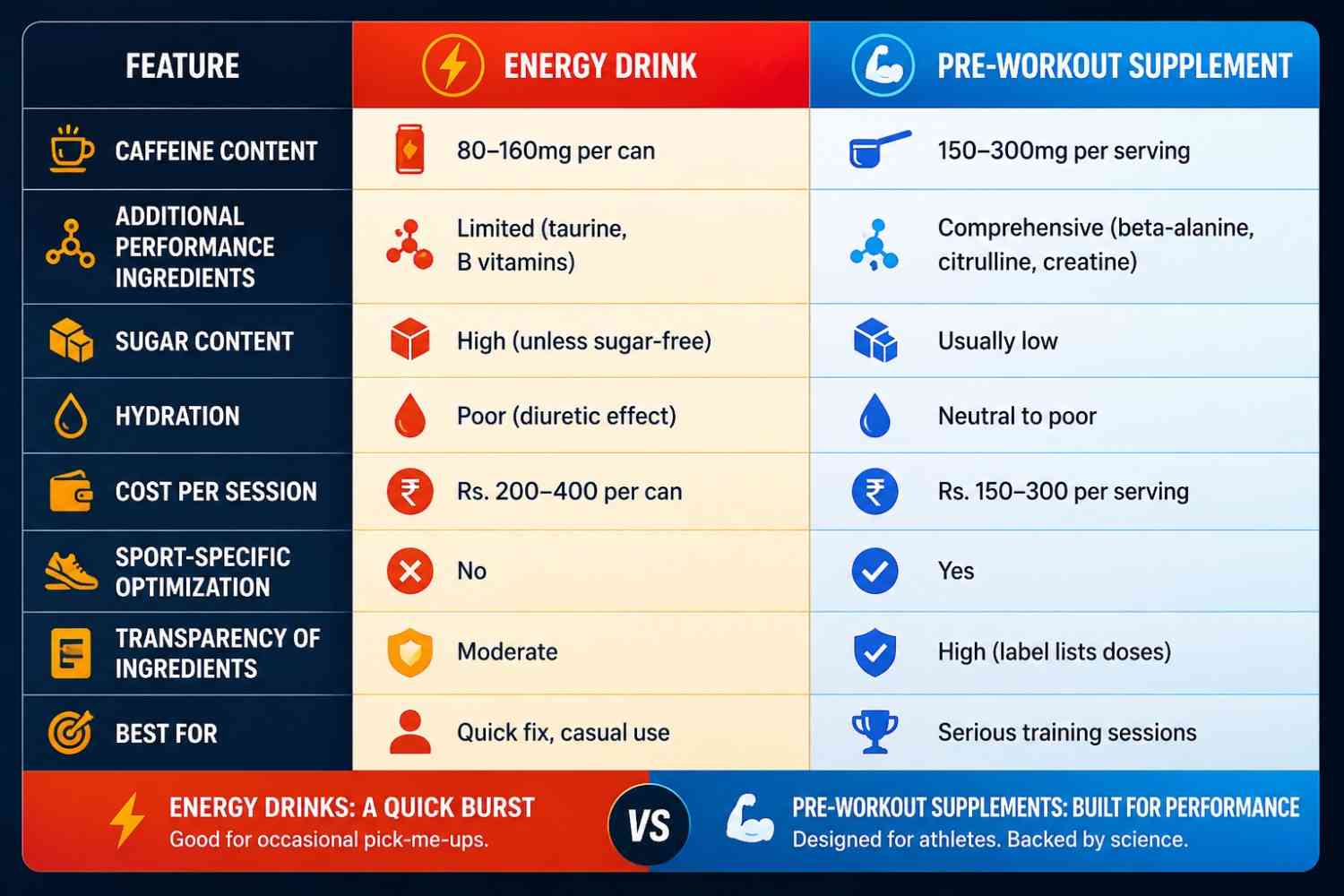
The honest answer: for serious Pakistani athletes who train consistently, a proper pre-workout supplement is almost always a better choice than an energy drink. The ingredient profile is more complete, the sugar is lower, and the doses are designed around athletic performance rather than general alertness.
Energy drinks are better for casual situations — a long drive, an evening studying, an occasional boost before a match when you don’t have your pre-workout with you. They’re not designed for the daily serious training that elite sport demands.
Read our Best Pre-Workout Supplements Pakistan 2026 guide for the full breakdown of proper pre-workout options available here.
7. Who Should Avoid Energy Drinks Completely
Under 18 — Full Stop
This is non-negotiable. Young athletes have developing cardiovascular systems, developing hormonal balances, and developing neurological systems. Energy drinks increase blood pressure and heart rate in ways that carry more risk for developing bodies than for adults. The sales ban for minors implemented in several countries has already significantly reduced consumption among youth athletes. Pakistani parents of young cricketers, footballers, and kabaddi players should be aware of this.
Anyone with Heart Conditions
Even undiagnosed arrhythmias, valve issues, or hypertension can be dangerously aggravated by the caffeine and taurine combination in energy drinks during intense exercise. If you’ve ever felt an irregular heartbeat during exertion, get a cardiac check before consuming energy drinks.
Pregnant Women
Caffeine crosses the placenta. High caffeine intake during pregnancy is associated with increased miscarriage risk and low birth weight. Energy drinks during pregnancy are not safe.
Anxiety Disorders
Caffeine is a stimulant that directly worsens anxiety. Athletes already dealing with performance anxiety, generalized anxiety, or panic disorder will find energy drinks make these conditions significantly worse — not better.
Kidney Disease
The combination of high caffeine, high sugar, and artificial additives puts strain on the kidneys. Anyone with known kidney disease or family history of kidney problems should avoid energy drinks or consult a doctor.
Evening Trainers
If you train after 6pm in Pakistan, stimulant-based energy drinks will disrupt your sleep. And poor sleep is the single biggest enemy of athletic recovery. Choose electrolytes and water instead.
Where to buy in Pakistan:
Supermarkets: Carrefour, Imtiaz, Hyperstar
Convenience stores and petrol stations (most widely accessible)
Online: Daraz.pk, Naheed.pk
Available nationwide across Lahore, Karachi, Islamabad, Rawalpindi, Faisalabad, and smaller cities
9. The Smarter Alternative — What Elite Athletes Actually Use
Here’s something worth knowing: most elite athletes don’t rely on commercial energy drinks for their performance nutrition. They use purpose-built supplements.
Creatine Monohydrate
The most researched performance supplement in sports history. Improves explosive power, speeds recovery between efforts, and maintains strength output across long training sessions. No crash. No cardiovascular risk. No sugar. Rs. 4,000–12,000 per tub that lasts 2 months. This is what serious Pakistani athletes should build their foundation on.
Read our full Creatine vs Whey Protein guide for a detailed comparison.
Electrolytes
For hydration during training in Pakistan’s heat — nothing beats electrolytes. They replace what sweat takes: sodium, potassium, magnesium, chloride. Energy drinks actually worsen dehydration. Electrolytes fix it. The two are not interchangeable.
Pre-Workout Supplements
Purpose-designed for athletic performance. Better caffeine dosing, additional performance ingredients (beta-alanine, citrulline malate), lower sugar, and no carbonation causing discomfort during training. See our Best Pre-Workout Supplements Pakistan guide for current options and prices.
Natural Caffeine Sources
A strong cup of green tea or black kahwa delivers 30–50mg of caffeine cleanly — without carbonation, excessive sugar, or artificial additives. For athletes who want a mild stimulant boost without the risks of a full energy drink, natural caffeine sources are worth considering.
10. Frequently Asked Questions
Are energy drinks banned in sport?
Energy drinks themselves are not banned by WADA (World Anti-Doping Agency) or most sports governing bodies. However, some specific ingredients in certain brands — particularly high-dose synephrine or obscure herbal extracts — can appear on prohibited lists. Athletes competing at national or international level should check the exact ingredient list of any energy drink against the current WADA prohibited list before consuming it during competition periods.
Can I drink energy drinks during Ramadan fasting in Pakistan?
During the fasting period from Sehri to Iftar, no. Energy drinks contain calories (from sugar) that break the fast. After Iftar, if you train in the evening, an energy drink can be consumed pre-training the same way you would any other day. However, the sleep disruption risk is amplified during Ramadan because fasting affects your circadian rhythm. High-caffeine drinks late at night during Ramadan will worsen sleep quality significantly. Electrolytes after Iftar are a safer performance choice.
Is Sting a good energy drink for sports in Pakistan?
Sting is one of the most affordable and widely consumed energy drinks in Pakistan. A standard 250ml can contains approximately 72mg of caffeine — close to Red Bull’s 80mg and significantly more than the 34mg figure often cited online, which refers to older or regional formulations. Sting also contains taurine, B vitamins, ginseng extract, and inositol a reasonably complete formula for its price point. For casual training use, Sting is a legitimate option. For high-performance sessions requiring 150mg+ of caffeine, you’d need two cans at which point a dedicated pre-workout becomes more practical and cost-effective.
How many energy drinks per day is safe for athletes?
Most health guidelines recommend no more than 400mg of caffeine per day for healthy adults. That’s roughly 5 cans of Red Bull or 2–3 cans of Monster. In practice, athletes should aim significantly lower — 1 standard can (80–160mg caffeine) before training is the sensible upper limit for daily use. Even at that level, taking breaks from caffeine every 6–8 weeks is important to prevent tolerance buildup. Daily heavy energy drink use carries real cardiovascular and dependency risks over time.
Are sugar-free energy drinks better for athletes?
For athletic performance specifically yes, they’re better than the sugary versions. Sugar-free energy drinks eliminate the blood sugar crash that follows a high-sugar drink mid-session. The caffeine, taurine, and B vitamin profile remains the same. For weight management and body composition goals, sugar-free variants obviously carry fewer unnecessary calories. The trade-off: some athletes find the sweeteners in sugar-free variants cause digestive discomfort during exercise. Test before committing.
Can energy drinks replace water during sports?
No. This is one of the most dangerous misconceptions in Pakistani sports culture. Energy drinks do not hydrate. Caffeine is a mild diuretic — it actually increases fluid loss. Replacing water with energy drinks during exercise in Pakistan’s heat is a recipe for dehydration, muscle cramps, heat exhaustion, and in extreme cases, heat stroke. Drink water and electrolytes during exercise. Energy drinks are a pre-exercise tool, not a during-exercise hydration solution.
Do energy drinks help in cricket?
They can, when used correctly. A moderate caffeine dose (80–160mg) 20–30 minutes before a fielding session or batting innings can improve focus, reaction time, and reduce perceived fatigue. The problem comes with timing and heat management. A fast bowler sipping a sugar-based energy drink between overs in 40°C Lahore heat is not managing hydration intelligently. Cricket is a long game. Use caffeine strategically, before the start of a key session and hydrate with water and electrolytes throughout.
Who Should Use Them (Red Bull, Gatorade)?
Choose Red Bull for short-term focus before demanding activity. Choose Gatorade during or after long, sweaty exercise.
Can You Drink Both Red Bull & Gatorade?
Yes, but usually there is no need. If used together, Red Bull is typically consumed before activity for focus, while Gatorade is used during or after exercise for hydration.
Final Thoughts
Energy drinks work. The science is clear on that. Caffeine improves athletic performance, sharpens focus, delays fatigue, and helps athletes push harder for longer.
But they also carry real risks when overused — cardiovascular stress, dehydration, sugar crashes, sleep disruption, and long-term dependency. In Pakistan’s heat, with the physical demands of cricket, football, kabaddi, and gym training, using them without understanding these risks is genuinely dangerous.
The smart approach: use energy drinks occasionally, not daily. Never during exercise — only before it. Never as a hydration tool. Never after 5pm if you want to sleep properly. And never as a substitute for proper sports nutrition — creatine, whey protein, electrolytes, and a decent diet will do more for your long-term performance than any number of Red Bulls.
If you want the stimulant benefits of energy drinks without the downsides, a purpose-built pre-workout supplement is almost always the better investment.
Share This Article

Written by : Mubashar Nazar
Mubashar Nazar is a sports enthusiast and the founder of TheSportans.com. With hands-on experience in archery and sports training, he shares practical guides, product insights, and expert tips to help athletes choose the right gear and improve performance, and sports management professional with hands-on experience in training, event coordination, and athlete development.
Follow Us
Latest Articles
October 15, 2026

October 15, 2026
October 15, 2026