
BCAA vs EAA – Do They Build Muscle or Just Empty Your Wallet?

Last month someone messaged us on WhatsApp. He’d been training for eight months, taking BCAAs every single session, and spending Rs. 9,000 per month on them. His question was simple: “Bhai, am I wasting money?”
Short answer – yes. Long answer – it depends on things nobody told him when he bought them.
BCAAs and EAAs are two of the most purchased supplements in Pakistan right now. They’re also two of the most misunderstood. Most people buy them because someone at the gym said to, or because the packaging looked serious, or because a fitness influencer was holding a bottle. Almost nobody buys them after actually understanding what they do – and more importantly, what they don’t do.
That changes today.
This guide tells you exactly what BCAAs are, what EAAs are, how they’re different, what the research says, and whether you – specifically – should spend money on them. No marketing language. No both-sides-are-great diplomacy. Just what’s true and what’s worth your rupees.
1. Amino Acids — The Foundation
Before comparing BCAAs and EAAs, it helps to understand what amino acids actually are and why they matter.
Your body is made largely of protein. Muscles, organs, enzymes, hormones, neurotransmitters – protein is involved in almost everything your body does. And protein is built from amino acids.
There are 20 amino acids in total. Your body can produce 11 of them on its own – these are called non-essential amino acids because you don’t need to get them from food. The remaining 9 cannot be made by your body at all. You must get them from food or supplements. These are the essential amino acids (EAAs).
Among those 9 essential amino acids, 3 have a unique branched molecular structure. These three – leucine, isoleucine, and valine – are called BCAAs (Branched-Chain Amino Acids). They’re a subset of the EAA family, not a separate category.
This is the relationship most people miss:
- All BCAAs are EAAs
- Not all EAAs are BCAAs
- EAAs include BCAAs plus 6 more essential amino acids
2. What Are BCAAs?
BCAAs are made up of three essential amino acids: leucine, isoleucine, and valine.
What makes them special compared to other amino acids is where they’re processed. Unlike most amino acids that are broken down in the liver, BCAAs are primarily metabolized directly in your muscles. This means they can be used quickly during exercise and play a role in muscle protein synthesis — the process your body uses to build and repair muscle.
What each BCAA does:
Leucine: The most important of the three. Leucine directly triggers the mTOR pathway — the molecular switch that signals your body to start building muscle protein. Without sufficient leucine, muscle protein synthesis doesn’t get initiated properly. This is why leucine is considered the “trigger” amino acid. Most quality BCAA supplements use a 2:1:1 ratio of leucine to isoleucine to valine for this reason.
Isoleucine: Supports energy production during exercise. It helps regulate blood sugar and promotes glucose uptake into muscle cells during training. Also contributes to muscle repair alongside leucine.
Valine: Primarily supports muscle metabolism and provides energy during endurance activities. Helps prevent muscle breakdown during prolonged exercise.
Why people take BCAAs:
- To reduce muscle breakdown during fasted training
- To decrease muscle soreness after training
- For intra-workout energy during long sessions
- To support recovery when full protein intake isn’t possible
3. What Are EAAs?
Essential Amino Acids (EAAs) are all nine amino acids your body cannot produce on its own:
- Leucine (also a BCAA)
- Isoleucine (also a BCAA)
- Valine (also a BCAA)
- Lysine: Supports calcium absorption, collagen production, and immune function
- Methionine: Supports liver function, fat metabolism, and detoxification
- Phenylalanine: Precursor to dopamine and adrenaline (affects mood and focus)
- Threonine: Supports gut health, immune function, and collagen synthesis
- Tryptophan: Precursor to serotonin (affects mood, sleep, and appetite regulation)
- Histidine: Supports tissue repair, immune response, and myelin sheath formation
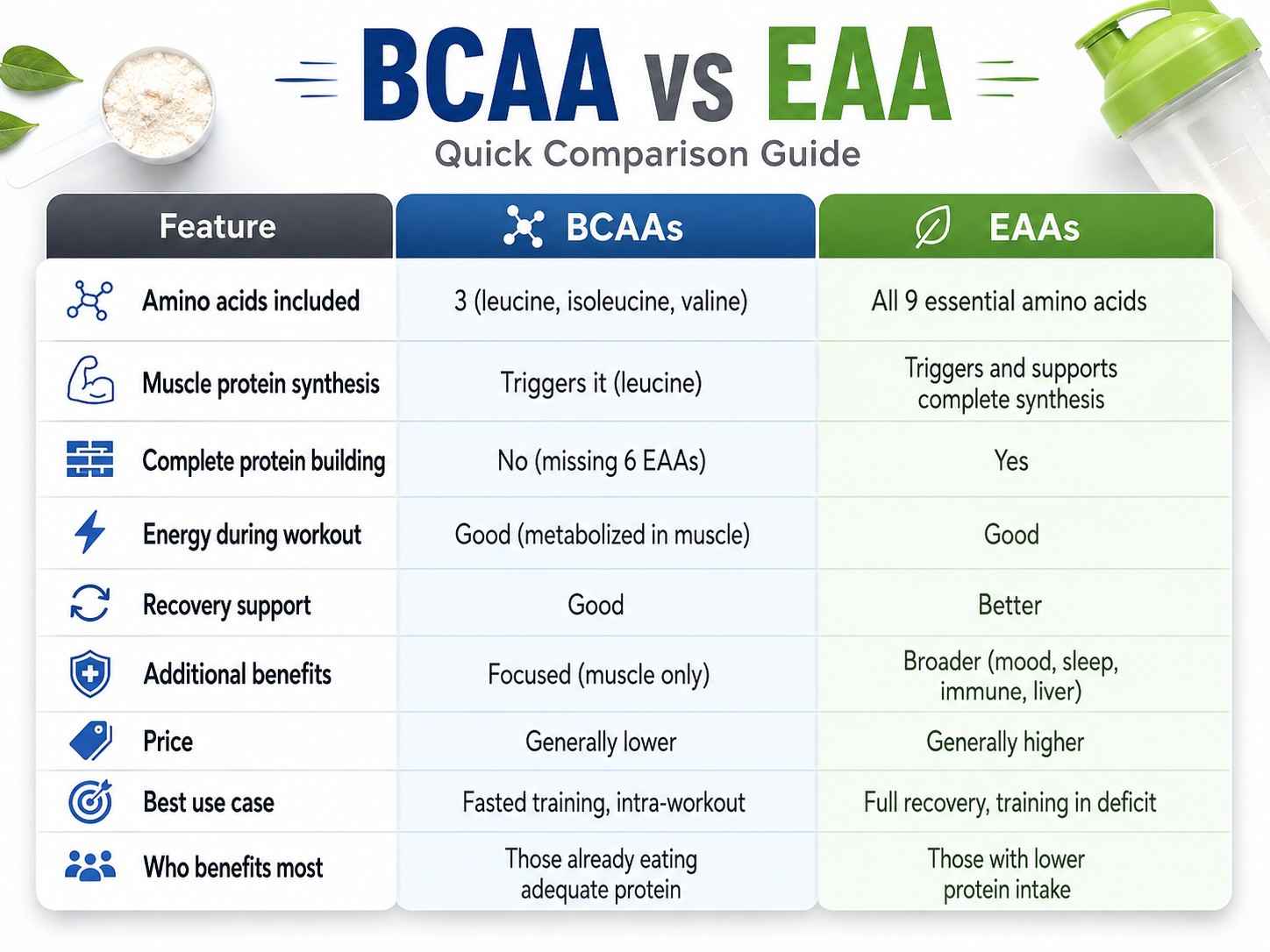
EAA supplements provide all nine of these. They contain the three BCAAs plus the six additional essential amino acids that BCAA supplements don’t include.
Why this matters: Your body needs all nine EAAs to build complete proteins. Muscle tissue is made of protein, and protein requires all essential amino acids. When you consume only BCAAs, you provide the signal for muscle building (leucine triggers mTOR) but you lack the raw materials to complete the process. It is like hiring construction workers but not giving them any bricks. EAAs provide both the signal and the building materials.
4. BCAA vs EAA — The Key Differences
5. What the Research Actually Says
Most supplement marketing cherry-picks studies. So let’s look at what the full picture actually shows.
BCAAs do stimulate muscle protein synthesis – that part is real. One study measured a 22% increase in muscle protein synthesis from 5.6g of BCAAs compared to a placebo. Sounds solid. But the same researchers found that a similar amount of whey protein – which contains all nine EAAs – increased muscle protein synthesis by 50%. Not 22%. Fifty.
That gap matters. Your body can’t build complete muscle protein from three amino acids alone. It needs all nine. BCAAs pull the trigger but EAAs actually load the gun. The construction workers and bricks analogy from Section 3 is exactly what’s happening biochemically.
Where BCAAs genuinely pull ahead is during fasted training. If you’re training before Sehri during Ramadan, or hitting the gym at 5am before eating, a small BCAA dose (particularly leucine) prevents your body from cannibalizing muscle for fuel. You get muscle protection without a full meal or a calorie-heavy protein shake.
One more thing the marketing doesn’t tell you about EAAs – they affect your brain, not just your muscles. A clinical study found EAA supplementation improved executive function (focus, decision-making ability) after aerobic exercise. This happens partly because tryptophan – present in EAAs but absent in BCAAs – is a precursor to serotonin. Better mood, sharper focus, improved sleep. BCAAs give you none of that.
If you’re choosing between the two for muscle building and recovery – EAAs win. More complete, better science, broader benefits. BCAAs have specific situations where they’re genuinely the smarter choice. But as a general muscle-building supplement, EAAs are the stronger option.
6. When BCAAs Make Sense
Despite EAAs being more complete, BCAAs are still a legitimate supplement in specific situations:
Fasted morning training: If you train before eating – common in Pakistan during early morning gym sessions before work or after Fajr – BCAAs prevent your body from breaking down muscle for fuel. A 5–10g BCAA dose before or during fasted training protects muscle without requiring a full meal.
Ramadan training: During Ramadan, many Pakistani athletes train after Taraweeh or just before Sehri. Both involve significant fasting periods. BCAAs consumed during or around training reduce muscle catabolism during the fast. Their low calorie content means they don’t significantly affect fasting from a nutritional perspective.
Long training sessions (90+ minutes): During extended training – long cricket nets, endurance runs, football practice – BCAAs can be sipped intra-workout to maintain energy and reduce muscle breakdown. EAAs work too but cost more per serving.
Already eating adequate protein: If you’re hitting 1.6–2g of protein per kg of body weight daily through food and whey (read our Creatine vs Whey Protein guide), you already have all nine EAAs coming in from whole protein sources. In this case, BCAAs can add targeted intra-workout support without unnecessary cost.
Budget constraints: BCAAs are typically cheaper than EAAs. For Pakistani athletes on a tight supplement budget who already take whey protein and creatine, BCAAs represent a cost-effective addition for specific purposes.
7. When EAAs Make Sense
EAAs are the better choice in these situations:
Lower protein intake from food: If your daily diet isn’t consistently hitting your protein targets – common for students, busy professionals, or anyone with limited access to quality protein sources – EAAs provide complete amino acid coverage that BCAAs simply can’t match.
Training in a calorie deficit: When you’re cutting (eating fewer calories to lose fat), your protein needs actually increase to protect muscle. EAAs provide full recovery support during a deficit. Read our Whey Protein for Weight Loss guide for how this fits into a complete cutting strategy.
Vegetarian or plant-based diet: Plant protein sources often lack one or more essential amino acids. EAA supplements bridge this gap completely. For Pakistani vegetarians whose protein intake relies heavily on daal and dairy, EAAs are more useful than BCAAs.
Recovery support beyond just muscle: EAAs support immune function, liver health, mood, and sleep through tryptophan and methionine – benefits BCAAs don’t provide. For athletes with high training volumes who are constantly stressed and recovering, EAAs offer more complete support.
Replacing BCAAs entirely: If you’re going to choose one amino acid supplement and your protein intake isn’t already excellent, EAAs are the more logical investment. You get everything BCAAs offer plus the additional six essential amino acids.
8. Do You Need Either If You Take Whey Protein?
Nobody wants to hear this answer because it means spending less money. But it’s the truth.
If you’re consistently hitting 1.6–2g of protein per kg of bodyweight daily through food and whey – you’re already getting all nine EAAs multiple times a day. Your chicken has them. Your eggs have them. Your whey shake has them. Adding a BCAA or EAA supplement on top of that changes almost nothing about your results.
A lot of Pakistani gym-goers are spending Rs. 8,000–10,000 per month on BCAAs while eating decent amounts of chicken and drinking whey protein. That’s money going nowhere.
The only real exception is fasted training. If you’re in the gym before eating – early morning sessions, Ramadan training around Sehri – BCAAs protect muscle during that window when no protein is circulating. That’s a legitimate use case.
Otherwise, fix your protein intake from food and whey first. Read our Creatine vs Whey Protein guide to understand how to structure that properly.
The practical priority for most Pakistani gym-goers:
- Get diet right (enough calories and protein from real food)
- Add whey protein if food isn’t cutting it
- Add creatine for performance
- Add BCAAs only for fasted training or Ramadan
- Consider EAAs if protein intake is still consistently falling short
BCAAs and EAAs are supplements for people who’ve already handled the basics. Most people in Pakistan haven’t – and they’re buying amino acids instead of fixing the foundation.
9. Best BCAA and EAA Products in Pakistan 2026
Scivation Xtend BCAA – Most Popular in Pakistan
Xtend is scientifically formulated to maximize training intensity and promote optimal muscle protein synthesis and recovery while you train. It’s the most recognized BCAA product in Pakistan and for good reason – the formula is solid and the flavors are genuinely good.
What’s in it: 7g BCAAs per serving (2:1:1 ratio), electrolytes, glutamine, citrulline malate
What makes it stand out: The addition of electrolytes is a major plus for Pakistani athletes training in heat — your BCAA drink also handles hydration. Citrulline malate supports blood flow and pump. The combination makes it one of the better intra-workout options available here.
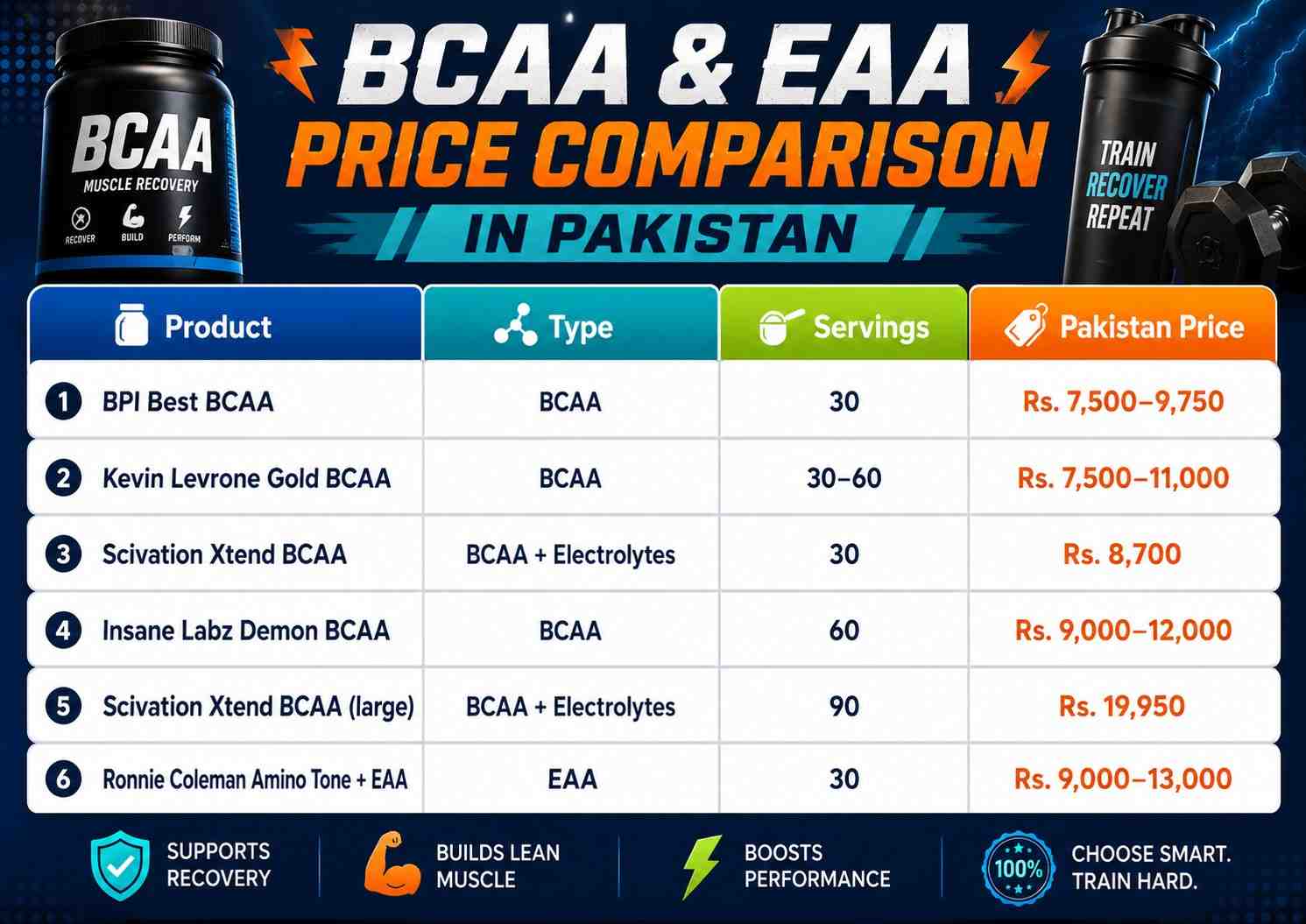
Pakistan Price: Rs. 8,700–19,950 (30–90 servings depending on size) Best For: Intra-workout, fasted training, Ramadan training
Kevin Levrone Gold BCAA — Best Value Mid-Range
Kevin Levrone Gold BCAA follows the same quality-focused approach as the rest of the Levrone supplement line. Solid formula, reliable quality, and available in Pakistan at reasonable prices.
What’s in it: BCAAs in 2:1:1 ratio, added vitamins and minerals Pakistan Price: Rs. 7,500–11,000 Best For: Budget-conscious athletes who want a quality BCAA without importing premium brands
Insane Labz Demon BCAA — Best for High-Intensity Training
Insane Labz Demon BCAA is a high-quality intra-workout supplement designed to support muscle recovery, endurance, and muscle protein synthesis. It features a potent blend of essential branched-chain amino acids.
Pakistan Price: Rs. 9,000–12,000 (60 servings) Best For: High-intensity training, athletes who also use Insane Labz pre-workout (stacks well)
Ronnie Coleman Amino Tone + EAA — Best EAA Option
For those specifically wanting EAAs, Ronnie Coleman Amino Tone + EAA is a cutting-edge amino acid supplement tailored for individuals dedicated to optimizing their workout performance and ensuring swift recovery.
What’s in it: Full EAA profile (all 9 essential amino acids), added toning support Pakistan Price: Rs. 9,000–13,000 (30 servings) Best For: Complete recovery support, athletes with lower dietary protein intake, cutting phases
BPI Best BCAA — Budget-Friendly Option
BPI Best BCAA uses a peptide-bonded formula for faster absorption and superior muscle recovery. Good option for those starting with BCAAs at an accessible price.
Pakistan Price: Rs. 7,500–9,750 Best For: Beginners trying BCAAs for the first time, budget-conscious athletes
10. Real Prices in Pakistan 2026
11. FAQ’s
What does BCAA actually do?
BCAA helps support muscle recovery and may reduce soreness after hard workouts, especially when your overall protein intake is low.
Is BCAA better than creatine?
No, creatine is usually more effective for strength, power, and muscle performance, while BCAA mainly supports recovery and amino acid intake.
Is it good to take BCAA every day?
Taking BCAA daily is generally fine, but it is not always necessary if you already eat enough protein from food or whey protein.
What does BCAA do to our body?
BCAA provides key amino acids that your muscles use during exercise, helping with recovery, reducing fatigue, and supporting muscle repair.
Can I take BCAAs and EAAs together?
You can but you’re doubling up for no reason. EAAs already include leucine, isoleucine, and valine — the three BCAAs. Taking both in the same session means you’re paying for two products that overlap almost entirely. Pick one. If your protein intake is strong, go BCAAs for fasted training. If your diet is inconsistent, go EAAs for complete coverage.
Should I take BCAAs before or after a workout?
During fasted training — take them before you start or sip throughout the session. This is where timing actually matters because there’s no protein in your system and your muscles need protection. If you’ve eaten a meal or had a whey shake before training, timing is irrelevant — just take them when it’s convenient. The idea that there’s a precise “anabolic window” has been significantly overstated in fitness marketing.
Are BCAAs and EAAs halal in Pakistan?
The active amino acids themselves — leucine, isoleucine, valine, and the rest — are typically synthesized through fermentation of plant sources and are halal. The issue is usually the capsule shell. Gelatin capsules come from animal bones and may not be halal. Powder-based BCAAs and EAAs like Scivation Xtend avoid this issue entirely. If you’re buying capsule-based products, look specifically for “vegetable capsules” on the label or contact the brand directly.
Do BCAAs break a fast during Ramadan?
Technically they contain calories — around 20–30 per serving — so they’re not truly fasting-compatible. Practically speaking, most athletes and Islamic scholars treat training-related supplement use differently from eating. If you’re training hard during Ramadan and concerned about muscle loss, a small BCAA dose around your training window is a pragmatic choice. If you’d rather stay clean during the fast, save BCAAs for after Iftar before your training session.
Are BCAAs and EAAs worth it for beginners?
No. Not because they’re harmful — they’re not — but because the money is better spent elsewhere. If you’re in your first six months of training, whey protein and creatine will produce more visible results than any amino acid supplement. BCAAs and EAAs are optimizations for people who’ve already built a solid foundation. Build the foundation first.
What’s the difference between BCAA ratios (2:1:1 vs 4:1:1)?
The ratio tells you how much leucine you’re getting relative to isoleucine and valine. A 2:1:1 gives you 2 parts leucine for every 1 part of the other two. A 4:1:1 doubles the leucine. Since leucine triggers muscle protein synthesis, brands market higher ratios as superior. In practice, the extra leucine in a 4:1:1 is unlikely to produce noticeably different results if you’re already eating adequate protein — you’re already getting plenty of leucine from your food. The 2:1:1 ratio has the most research behind it. Don’t pay extra for a higher ratio unless you have a specific reason to.
Share This Article

Written by : Mubashar Nazar
Mubashar Nazar is a sports enthusiast and the founder of TheSportans.com. With hands-on experience in archery and sports training, he shares practical guides, product insights, and expert tips to help athletes choose the right gear and improve performance, and sports management professional with hands-on experience in training, event coordination, and athlete development.
Follow Us
Latest Articles
October 15, 2026

October 15, 2026
October 15, 2026