
Professional Archery Arrow Selection for Competition – Pakistan 2026 Guide

If you’ve been shooting for a while and you’re serious about competition, you already know that equipment matters. Not in the way beginners think – where a more expensive bow magically fixes their form – but in a real, measurable way that shows up on your scorecard over time.
This guide is not for beginners. If you’re just starting out, read our Best Archery Arrows for Beginners in Pakistan guide first.
This guide is for professional archers who understand their draw weight, know what ‘spine’ means, have shot enough arrows to know when something isn’t right, and want to take their competition scores to the next level.
We’ll cover the top arrow brands, how to select the right spine based on your draw weight and draw length, specific arrow models with real accuracy data, why some pros switch to tungsten points, and what arrows Pakistani competitive archers actually shoot.
1. Top Arrow Brands for Competition Archery
The archery arrow market has a handful of brands that dominate competition at district, national, and international level. Understanding what each brand stands for helps you make a smarter buying decision.
Easton Archery
Easton is the most widely used competition arrow brand in the world. Doug Easton began the company in 1922, starting out of his garage in California, hand-crafting high-quality wood arrows. His claim to fame came in 1940 when he started producing perfectly straight aluminum arrows. The next big leap forward was in the 1980s when Easton pioneered the carbon arrow.
Today, Easton makes arrows that are shot at every Olympic Games. Their X10 model is arguably the most decorated arrow in competitive archery history. When you see podium finishers at World Archery championships, most of them are shooting Easton.
What makes Easton stand out:
- Extremely tight straightness tolerances (±0.001″ on Match Grade models)
- Precision spine alignment on all competition arrows
- Aluminum-carbon hybrid construction (FMJ series) for higher weight with smaller diameter
- Widest range of competition-specific models available globally
Best Easton models for competition:
- Easton X10 – Olympic-level recurve (the benchmark for international competition)
- Easton X10 Parallel Pro – High-level competition (lighter version of X10 and economical)
- Easton ACE – High-level competition arrow (slightly more affordable than X10)
- Easton FMJ 4MM – For compound competition and hunting
Gold Tip
You can’t go wrong with names like Easton, Gold Tip, and Carbon Express — they’ve really made a name for themselves with arrows that are not just reliable but also durable and performance-oriented.
Gold Tip has built a reputation for producing high-quality carbon arrows at prices that don’t require a second mortgage. Their arrows are consistently spine-aligned, which matters enormously at distance. Their Pro series is used in serious competition, while their Hunter series has dominated bowhunting for two decades.
What makes Gold Tip stand out:
- Strong quality control (consistent spine across the dozen)
- Good price-to-performance ratio
- Available in Pakistan through select retailers
- Proven competition track record
Best Gold Tip models for competition:
- Gold Tip Pro 22 — High-level target competition
- Gold Tip Pierce — Recurve and compound competition
- Gold Tip Hunter Pro — Hunting + 3D competition
Carbon Express
Carbon Express occupies a solid mid-tier position between budget brands and premium Easton competition arrows. They introduced tool steel points as a compromise between stainless steel and tungsten — a move that showed real innovation.
What makes Carbon Express stand out:
- Dual Spine Weight Forward technology (front-weighted for better FOC)
- Good value at the mid-competition level
- Consistent quality from a reliable manufacturer
Best Carbon Express models for competition:
- Maxima RED — 3D competition
- Nano SST — Indoor/outdoor target
ACCMOS
ACCMOS is a brand we carry at TheSportans and one worth knowing for Pakistani archers. While not in the same tier as Easton X10 for Olympic-level competition, ACCMOS arrows represent excellent value for archers competing at provincial and National levels in Pakistan.
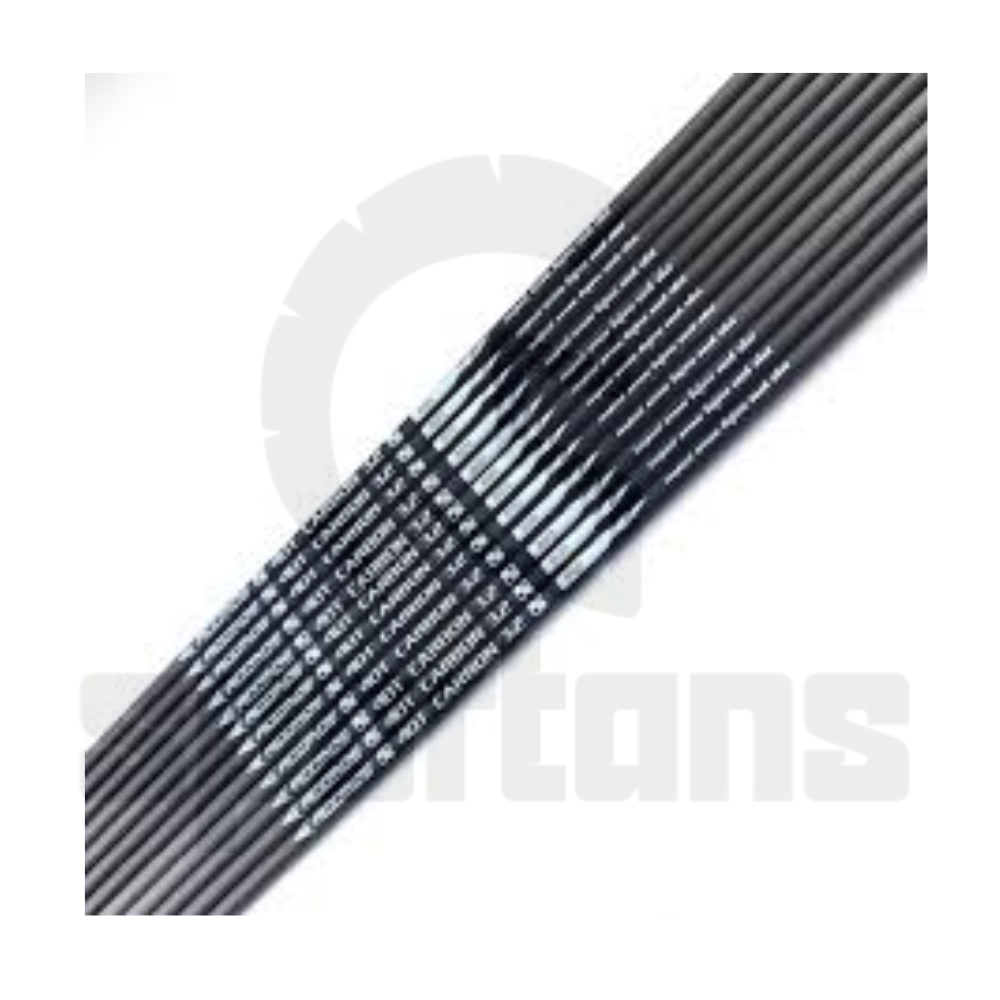
Accmos 40T Carbon Arrow ID 3.2mm
- 40T Carbon Construction
- 0.009″ Straightness
- 3.2mm Slim ID Shaft
- Compatible with Recurve & Compound Bows
Their 40T Carbon Arrow ID 3.2mm arrows are built to consistent tolerances and priced accessibly for the Pakistani market. If you’re competing seriously but aren’t yet at national team level, ACCMOS gives you performance that’s significantly better than generic Chinese arrows without the imported price tag of premium Western brands.
Pro Tip: If you want the excellent result use Easton X10 stainless points instead of it’s own.
Victory Archery
Victory is known for micro-diameter carbon arrows that cut through wind exceptionally well. The Victory VAP TKO is a micro-diameter (0.166) midweight carbon arrow that can be purchased in straightness tolerances of 0.003″. That carbon is made with Maxxke Technology, which is an advanced 3k carbon weave for better performance overall in terms of less torque and faster arrow recovery in flight.
Best Victory models for competition:
- VAP TKO — Premium hunting/competition hybrid
- RIP TKO — Long-distance competition
Pandarus Archery
Pandarus is a Chinese archery brand that has been gaining serious attention in the international competition community over the last few years — and for good reason. They produce aluminum-carbon hybrid arrows using CAC (Carbon-Aluminum Core) construction that directly challenge Easton’s X10 and ACE in terms of design philosophy, at a significantly lower price point.
For Pakistani competitive archers who want high-performance hybrid arrows without paying full Easton import prices, Pandarus deserves serious consideration. Here’s a breakdown of their three main competition models.
Pandarus CA320 Elite – The Entry Point into Pandarus Competition Arrows
The CA320 Elite is where Pandarus gets seriously competitive with Easton. This is their flagship arrow for Olympic-style recurve shooting — designed specifically for long-distance outdoor target competition at 50m and 70m.
The key change from the XT is the shaft shape. Where the XT is parallel (same diameter throughout), the CA320 Elite uses a barreled or “spindled” profile — thicker in the middle, tapered at both ends. This is the same concept Easton uses in the X10. The barrel shape improves structural rigidity at the midpoint while the tapered ends reduce drag and improve clearance through the bow window at release.
This design difference matters more at distance. At 18 meters, you won’t feel it much. At 70 meters in crosswind conditions, the barreled CA320 Elite holds its line noticeably better than parallel-shaft arrows.
Full Specs:
| Specification | Details |
|---|---|
| Construction | CAC — Barreled/Spindled design |
| Core Material | Aluminum alloy |
| Outer Layer | Carbon fiber |
| Shaft Diameter | 3.2mm (micro-diameter) |
| Straightness Tolerance | ±0.0015″ |
| Weight Tolerance | ±1.0 grain |
| Available Spines | 370, 400, 430, 470, 520, 570, 620, 670, 720, 780, 850, 920, 1000, 1100, 1250 |
| GPI Range | 5.1 gpi (1250 spine) to 7.9 gpi (370 spine) |
| What’s Included | Steel points, aluminum nock pins, large pin nocks, aluminum protective tangs |
| Best For | Olympic recurve, outdoor target 50m–70m, barebow |
| Design Shape | Barreled (barrel-shaped, tapered toward ends) |
Pakistan Price: Rs. 90,000–100,000 per dozen (imported)
Who should use it:
Archers stepping up from generic carbon arrows who want proper aluminum-carbon construction without paying Easton ACE prices. Good starting point in the Pandarus range for archers shooting at provincial or serious club level.
One thing to know: Do not use hot melt adhesive with CAC arrows. If you must use it, keep the temperature as low as possible. This is important — high heat can damage the bond between the aluminum core and carbon outer layer.
Important note on cutting:
For recurve bows, cut from the front only. For compound bows, the tail can be trimmed by up to 2 inches — but re-verify spine after any cut.
Pandarus CA320 Elite Pro — The Compound Competition Model
The CA320 Elite Pro is the most specialized of the three. While the CA320 Elite is primarily aimed at recurve and Olympic shooting, the Elite Pro was built from the ground up for compound bow competition.
The shaft uses a taper-front, parallel-tail design — the opposite profile to the Elite. The taper at the front reduces wind resistance and improves penetration through the bow window during compound release. The parallel tail section adds durability, since compound bow releases generate different mechanical stress on the rear of the arrow compared to finger-release recurve shooting.
Full Specs:
| Specification | Details |
|---|---|
| Construction | CAC — Taper front, parallel tail design |
| Core Material | Aluminum alloy |
| Outer Layer | Carbon fiber |
| Shaft Diameter | 3.2mm (micro-diameter) |
| Straightness Tolerance | ±0.0015″ |
| Best For | Compound bow target competition, all-distance compound |
| Design Shape | Taper front / Parallel tail |
| Competition Range | 18m indoor to 50m outdoor |
Pakistan Price: Rs. 95,000–110,000 per dozen (imported)
Who should use it: Competitive compound archers in Pakistan who want micro-diameter performance at a fraction of Easton FMJ pricing. The compound-specific design makes it more appropriate for compound shooting than the CA320 Elite, which leans toward recurve.
Pandarus CA320 XT – The Olympic Target Specialist
The CA320 XT is the foundation of Pandarus’s competition line. It uses a parallel shaft design with a 7075 alloy core wrapped in high-modulus carbon fiber — the same CAC construction principle used throughout the Pandarus ELITE family.
The parallel design makes it versatile. It works well for both indoor target shooting at 18 meters and outdoor competition up to 50 meters. Pandarus specifically recommends it for compound bow users, though it shoots cleanly from a well-tuned recurve setup too.
What stands out about the CA320 XT:
The CAC construction significantly reduces unwanted torsional flex during launch — one of the key factors that causes arrows to drift horizontally under crosswind conditions. The slim profile cuts through air resistance better than standard-diameter carbon arrows.
Full Specs:
| Specification | Details |
|---|---|
| Construction | CAC (Carbon-Aluminum Core) — Parallel design |
| Core Material | 7075 aluminum alloy |
| Outer Layer | High-modulus carbon fiber |
| Straightness Tolerance | ±0.0015″ |
| Weight Tolerance | ±1.0 grain |
| Available Spines | 350, 400, 450, 500, 550, 600, 650, 700, 750, 800, 850, 900, 1000 |
| OD at 500 spine | 5.20mm |
| GPI at 500 spine | 8.62 gpi |
| Stock Length | 32″ (spines 350–600), 31″ (spines 650–1000) |
| What’s Included | Stainless steel break-off points, nock pins, collars, pin nocks |
| Best For | Indoor target, compound competition, all-round training |
| Design Shape | Parallel (same diameter throughout) |
Pakistan Price: Rs. 110,000–120,000 per dozen (imported)
How it compares to Easton X10: The CA320 XT is widely discussed in international archery forums as an X10-equivalent in diameter and weight profile — but with spines that run approximately half a spine value weaker than X10 for the same number. This means if you were shooting X10 in a 500 spine, you’d want to try the CA320 XT in a 470 or 450 spine, not 500. Factor this in when selecting from the Pandarus spine chart.
One archer who shoots 580/720 on a recurve setup described it as closer to an X10 in character than the Easton ACE — particularly in terms of how it handles wind at 70 meters.
Pandarus CA320 Model Comparison at a Glance
| Model | Shape | Core | Best For | Pakistan Price |
|---|---|---|---|---|
| CA320 XT | Parallel | 7075 Alloy + Carbon | Recurve Olympic, outdoor 50–70m | Rs. 110,000 – 120,000 |
| CA320 Elite | Barreled (spindled) | Alloy + Carbon | Indoor, compound, all-round | 90,000 – 100,000 |
| CA320 Elite Pro | Taper front/parallel tail | Alloy + Carbon | Compound competition, all distances | Rs. 95,000 – 110,000 |
Tip: Want an affordable all-round hybrid arrow for training and club competition? Go CA320 XT
All three use the same core CAC construction principle. The differences are shaft geometry and the bow type each was optimized for. At TheSportans, we stock Pandarus arrows from verified sources — contact us for current availability and pricing.
2. Spine Selection Guide — Draw Weight & Draw Length
This is where most competitive archers either get it right or lose points they can’t get back. Spine selection isn’t optional. It’s the foundation of arrow tuning and accuracy.
What Is Arrow Spine?
Arrow spine is the stiffness rating of the arrow shaft. When an arrow leaves your bow, it flexes – this is called the Archer’s Paradox. If the spine is too stiff, the arrow can’t flex properly and corrects late, causing left or right drift. If it’s too weak, it flexes too much and oscillates throughout flight, costing you precision.
Getting spine right = arrows that fly consistently = tighter groups = better scores.
The Spine Number System
The lower the spine number, the stiffer the arrow.
- 300 spine — Very stiff, for heavy draw weights (60–80+ lbs)
- 340 spine — Stiff, for medium-heavy draw weights (55–70 lbs)
- 400 spine — Medium, for mid-range draw weights (45–60 lbs)
- 500 spine — Flexible, for lighter draw weights (35–50 lbs)
- 600 spine — Very flexible, for light draw weights (25–40 lbs)
- 700 spine — Ultra-flexible, for very light bows (under 30 lbs)
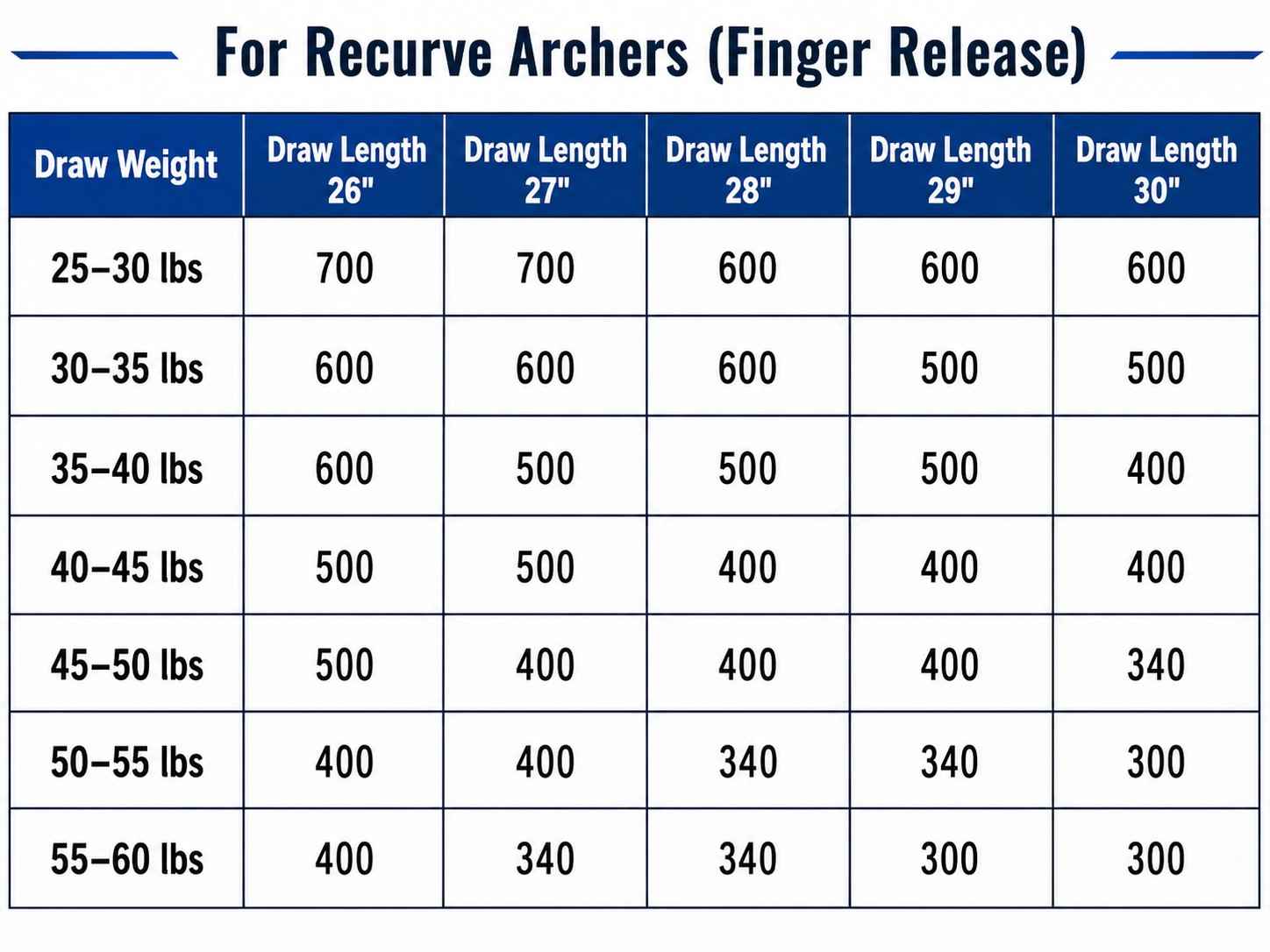
Spine Selection by Draw Weight and Draw Length
Use this chart as a starting point. Fine-tuning is still required through paper tuning or walk-back tuning once your arrows arrive.
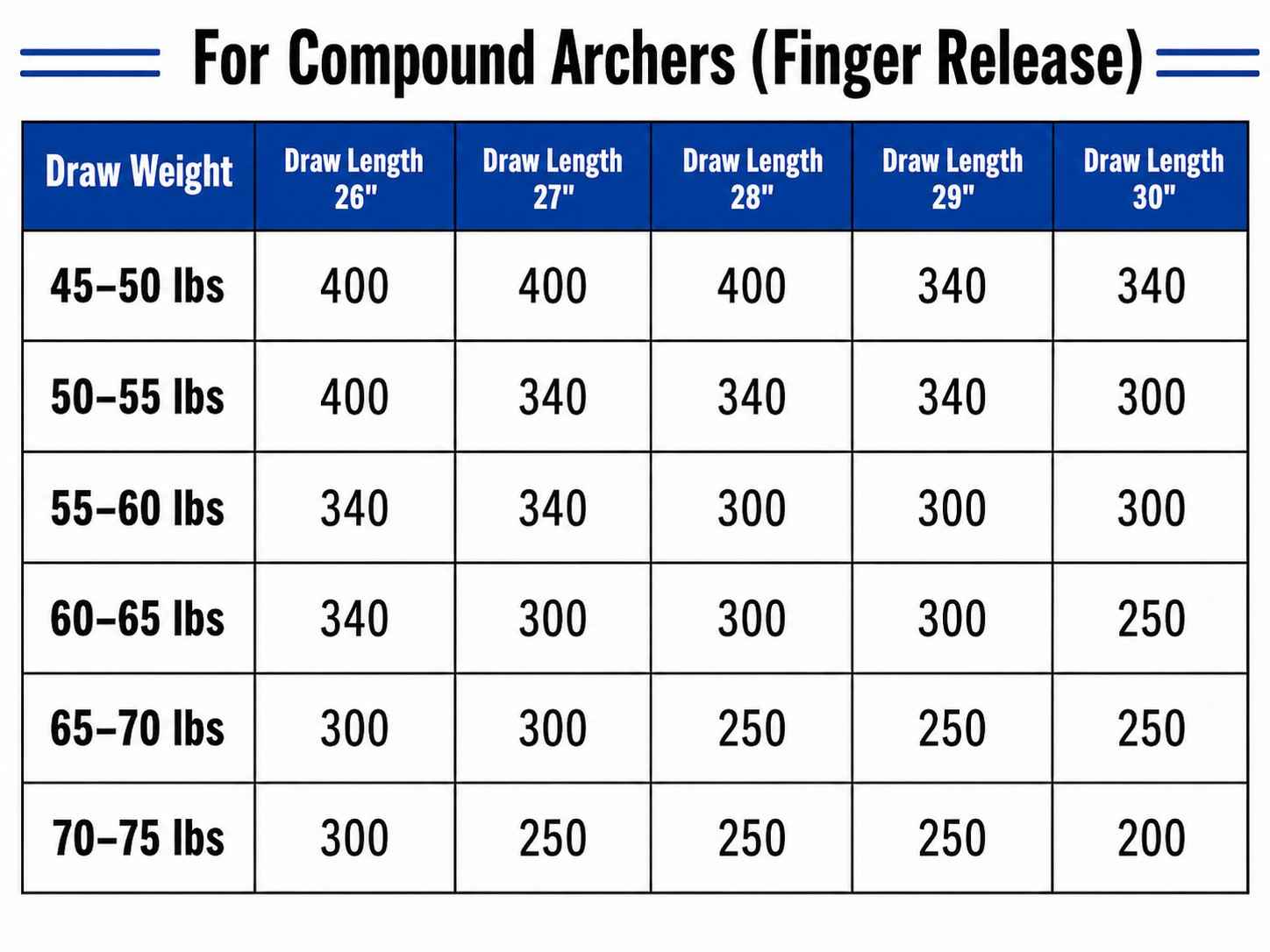
For Compound Archers (Mechanical Release):
Compound bows are more efficient than recurves, so you generally need a stiffer spine than the chart above suggests. Drop one spine weight stiffer than the recurve recommendation for the same draw weight.
Important: Point Weight Affects Spine
Adding heavier points makes your arrow behave weaker (more flexible). Adding lighter points makes it behave stiffer. For every 25 grains of point weight you add above 100 grains, adjust your spine selection one step weaker (higher spine number).
Example: You’re shooting 50 lbs draw weight, 28″ draw length. The chart says 400 spine.
Using 120-grain points → 600 spine and below is correct
Using 100-grain points → 600 spine to 900
Using 90-grain points → Move to 900 spine and above
Practical Tip: When In Doubt, Go StifferMost coaching experts agree: it’s better to be slightly stiff than slightly weak. An arrow that’s slightly too stiff will still group reasonably well. An arrow that’s too weak will oscillate and give you unpredictable results, especially at longer distances.
3. Top Arrow Models: Accuracy, Specs & Prices
Here’s a comparison of the top competition arrow models you’ll encounter in Pakistan and internationally, with real specs and pricing.
Easton X10
The competition benchmark. Used by Brady Ellison, Ki Bo Bae, and almost every Olympic medalist in recurve archery for the past two decades.
| Specification | Details |
|---|---|
| Material | Aluminum core / Carbon fiber outer wrap |
| Diameter | 4.2mm (very slim) |
| Straightness Tolerance | ±0.001″ (Match Grade) |
| Available Spines | 350, 380, 410, 450, 500, 550, 600, 650, 700 |
| Weight Range | 220–300 grains (shaft only) |
| Best For | Olympic recurve, indoor/outdoor target |
| Accuracy | Sub-1″ groups at 18m, sub-3″ at 70m when tuned |
| International Price | $180–$230 per dozen |
| Pakistan Price (imported) | Rs. 45,000–65,000 per dozen |
Who should use it: National team-level archers and above. If you’re scoring 550+ on a 600-point indoor round, the X10 is the right arrow. Below that score level, your form is the limiting factor — not your arrows.
Easton ACE
The X10’s slightly more affordable sibling. Used at world-class competition level but accessible to high-performing club archers.
| Specification | Details |
|---|---|
| Material | Carbon fiber |
| Diameter | 5.2mm |
| Straightness Tolerance | ±0.002″ |
| Available Spines | 420, 470, 520, 570, 620, 670, 720 |
| Best For | Outdoor target, 3D, intermediate-advanced competition |
| International Price | $120–$160 per dozen |
| Pakistan Price (imported) | Rs. 28,000–42,000 per dozen |
Who should use it: Serious competition archers at district and provincial level in Pakistan. Better value than X10 with 90% of the performance at most distances.
Gold Tip Pro 22
A competition-grade carbon arrow that’s well-regarded at club level internationally.
| Specification | Details |
|---|---|
| Material | 100% Carbon |
| Diameter | 5.6mm |
| Straightness Tolerance | ±0.002″ |
| Available Spines | 300, 340, 400, 500, 600 |
| Weight | Varies by spine (9.2–10.2 gpi) |
| Best For | Club competition, outdoor target |
| International Price | $70–$100 per dozen |
| Pakistan Price | Rs. 18,000–28,000 per dozen |
Who should use it: District-level competition archers who want consistent performance without importing premium arrows. Good balance of performance and accessibility in Pakistan.
ACCMOS 40T Carbon 3.2mm Competition Arrows
| Specification | Details |
|---|---|
| Material | 100% Carbon |
| Available Spines | 400, 500, 600, 700 |
| Straightness Tolerance | ±0.003–0.005″ |
| Best For | Province, and National Competitions |
| Pakistan Price | Rs. 20,000–25,000 per dozen |
Who should use it: Pakistani archers competing at club and district level who want proper competition arrows without importing at premium cost. Available directly at TheSportans with authentic stock.
Carbon Express Maxima RED
A well-engineered competition arrow with patented dual-zone spine technology.
| Specification | Details |
|---|---|
| Material | 100% Carbon |
| Diameter | 0.244″ |
| Straightness Tolerance | ±0.0025″ |
| Available Spines | 250, 350, 450 |
| Best For | 3D competition, outdoor target |
| International Price | $90–$130 per dozen |
| Pakistan Price (imported) | Rs. 22,000–32,000 per dozen |
4. Tungsten vs Stainless Steel Points: The Scoring Debate
This is a topic serious competition archers debate constantly. Stainless steel points are affordable, reliable, and perfectly capable of helping you shoot great scores. But if you’re a serious competitor looking for every edge in consistency and performance, tungsten can be a smart long-term investment. Easy to buy at TheSportans with different colors and weights of Tungsten Steel Arrowheads.
The Technical Difference
Tungsten is significantly denser than stainless steel — Tungsten has a density of 1204.86 pounds per cubic ft. Tungsten is 247% heavier than steel.
Because tungsten is denser, manufacturers can pack the same grain weight into a much shorter, more compact point. This changes how the weight sits relative to the arrow shaft.
What This Means in Practice:
Because tungsten is denser, the points are shorter, which allows the arrow to flex more. This can make the arrow slightly more forgiving and easier to tune.
Durability: Stainless steel points are prone to bending or getting dinged, especially on micro-diameter shafts. Tungsten resists both issues, staying straighter for longer.
Does It Actually Improve Your Score?
Here’s the honest reality from people who’ve measured both:
I measured FOC and using the same point weight between SS and tungsten, it was about 2% more.
A 2% improvement in FOC (Front of Center balance) is real but marginal. At district level competition, the difference between a 580 and a 590 score is mostly form. At Olympic selection level, 2% FOC could be the difference between a gold medal and silver.
It’s tempting to think the tungsten points are better, but for most archers, the stainless steel points are the best choice. The only time I’d recommend against stainless steel points is if you regularly shoot on targets that are made of really hard material, especially if this is in strong crosswinds.
Cost Comparison
Steel points may need replacement 2–4 times a year, often totaling Rs. 80–150+ annually. Tungsten points cost more upfront but hold their shape and surface far longer, often lasting multiple seasons.
In Pakistani terms:
- Stainless steel points (set of 12): Rs. 10,000 – 15,000
- Tungsten points (set of 12): Rs. 30,000 – 35,000
The Verdict for Pakistani Competitive Archers
- Club and district level: Use stainless steel. Put the money difference toward better arrows or coaching.
- Provincial and national level: Consider tungsten once your form is consistent and you’re chasing every fraction of a point.
- Olympic level or international selection: Tungsten is standard. The marginal gains matter at this level.
5. What Arrows Do Pro Archers in Pakistan Actually Use?
Pakistani archery has been quietly growing. At the competitive level — district, provincial, and national team archers — here’s what’s actually being shot:
National Team Level
Pakistani national team archers training for international competition largely shoot Easton X10 and Pandarus CA320-XT arrows when competing internationally. These are imported, expensive, and typically provided or subsidized through the Pakistan Archery Federation for selected athletes.
Provincial Level
At provincial championship level, you’ll see a mix of:
- Easton ACE (for those who can afford the import cost)
- Gold Tip Pro/Pierce (more accessible than X10, still high performance)
- Carbon Express Maxima (popular mid-tier option)
- ACCMOS 40T carbon 3.2mm (most accessible for Pakistani archers on a realistic budget)
Club Level (Most Common in Pakistan)
At club competition across Lahore, Karachi, Islamabad, Peshawar, and Quetta, the most commonly used arrows are:
- ACCMOS carbon arrows — Best local price-performance ratio
- Generic Chinese competition carbon — Affordable but inconsistent quality
- Easton Navigator — Entry-level Easton for those stepping up from beginner arrows
The Reality of Arrow Availability in Pakistan
Imported arrows (Easton, Gold Tip, Carbon Express) are available in Pakistan but come at significant import markup — typically 2.5x to 3.5x their international retail price.
This is why ACCMOS and locally stocked competition arrows represent the most practical choice for the majority of serious competitive archers in Pakistan. At TheSportans, we work to keep these prices as accessible as possible while guaranteeing authenticity.
7. Frequently Asked Questions
What type of arrows are best for hunting?
For hunting, you need a heavier, more penetrating arrow than what you’d use for target shooting. The best hunting arrows are carbon or carbon-aluminum hybrid shafts in the 400–500 grain total weight range, with broadheads of 100–125 grains. The one arrow that’s going to check all of the boxes is going to be the VAP TKO by Victory. From the quality to the performance, the TKO can handle any big game hunting in North America. For Pakistani hunting conditions, carbon arrows in the 400–500 grain range with a 100-grain broadhead are the most practical choice. Avoid fiberglass for hunting — they’re too heavy and imprecise at distance.
What are the 4 types of arrows?
The four main arrow shaft types are:
- Wood arrows: Traditional archery only. Not suitable for modern recurve or compound bows. Low durability.
- Fiberglass arrows: Best for beginners. Very durable but heavy. Not for serious competition.
- Aluminum arrows: Consistent, accurate, good for indoor target competition. Heavier than carbon. Can bend over time.
- Carbon arrows: The standard for all levels of serious competition and hunting. Lightweight, fast, precise, durable. Available in pure carbon, carbon-aluminum hybrid, and carbon with various coatings.
Is a 400 grain arrow enough for deer?
Yes, a 400 grain arrow is sufficient for deer hunting when paired with an appropriate broadhead and bow setup. The general rule in bowhunting is that heavier arrows penetrate better and are quieter. For deer-sized game, 350–500 grains is the accepted range. A 400 grain arrow from a 50–60 lb bow delivers enough kinetic energy for clean, ethical shots at standard hunting distances (under 40 yards). The arrow weight alone doesn’t determine effectiveness — penetration depends on the combination of arrow weight, speed, broadhead design, and shot placement.
How far will a 50 lb bow shoot an arrow?
A 50 lb bow can shoot an arrow accurately to different distances depending on the purpose:
Maximum range (arrow traveling any distance): 180–220 meters with a well-tuned setup
Effective hunting range: 30–40 meters maximum for ethical shot placement
Accurate target range: 40–50 meters for consistent grouping in competition
Olympic recurve competition distance: 70 meters (but national team archers typically use 38–45 lb bows, not 50 lb)
For Pakistani archers, 50 lb is common for adult recurve shooters. At this draw weight you’re well-suited for most club and district competition distances (18m indoor, 30m, 50m outdoor).
Is a 500 grain arrow too heavy for deer?
No, 500 grains is not too heavy for deer. In fact, many experienced bowhunters prefer heavier arrows (450–550 grains) specifically because they penetrate deeper, retain more momentum through muscle and bone, and are quieter at the shot. The trade-off is slightly less speed and a more arced trajectory, requiring precise range estimation. For hunting in Pakistan (wild boar, mountain ungulates), a 500 grain arrow from a 55–65 lb bow is a very capable setup.
What poundage is a 600 spine arrow good for?
A 600 spine arrow is designed for light draw weights. Here’s the practical range:
Recurve (finger release): 25–35 lbs draw weight
Compound (mechanical release): 20–30 lbs draw weight
In Pakistan, 600 spine arrows are typically used by:
- Youth archers (under 16) with lighter bow setups
- Women beginners on 25–30 lb bows
- Traditional archers with lighter longbows
If your bow is heavier than 35 lbs, a 600 spine is almost certainly too weak for your setup — your arrows will flex excessively and your groups will open up significantly, especially at distance.
Final Thoughts
If you’re competing seriously in Pakistan, arrow selection is not where you should cut corners. Your bow is the engine. Your form is the driver. Your arrows are the vehicle that connects both to the target.
For most Pakistani competitive archers, Pandarus and ACCMOS competition carbon arrows represent the best accessible starting point. As your scores improve and you move toward provincial and national level, gradually upgrading to Pandarus CA320 Elite, then Easton X10 Parallel, and eventually X10 if you reach national team level makes both technical and financial sense.
Don’t jump to X10 arrows if you’re shooting 490 on a 600-point round. Invest in coaching first. Equipment upgrades deliver results when your form is already consistent.
Share This Article

Written by : Mubashar Nazar
Mubashar Nazar is a sports enthusiast and the founder of TheSportans.com. With hands-on experience in archery and sports training, he shares practical guides, product insights, and expert tips to help athletes choose the right gear and improve performance, and sports management professional with hands-on experience in training, event coordination, and athlete development.
Follow Us
Latest Articles

October 15, 2026
October 15, 2026

October 15, 2026